Case Study: Electronic Hardware Design and Firmware Development – Chemical Dosing System
Project Overview
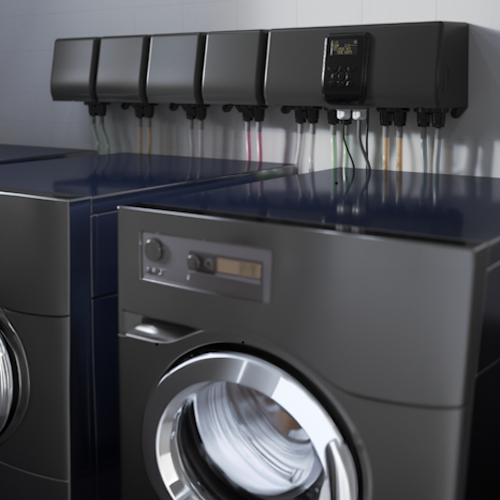
RVL partnered with an International Leading Dosing Design and Manufacturing Company from the very earliest concept stage to design and deliver Nexus, a highly capable, network-connected chemical dosing and control system for industrial washing environments. The project covered the complete product development lifecycle, from initial requirements capture and system architecture through to prototype manufacture, testing, and pre-compliance.
The result was a scalable, robust hardware and firmware platform capable of controlling multiple industrial washing machines, managing complex chemical dosing requirements, and securely integrating with cloud-based services and user applications.
Requirements Definition & System Architecture
Working collaboratively with the Client, RVL helped define the full hardware and firmware specifications, translating functional and commercial requirements into a structured Internet of Things (IoT) system architecture. A detailed project plan was produced, forming the basis of a fixed development and manufacturing quotation that covered:
- Electronic hardware design
- Firmware development
- Prototype PCBA manufacture (in-house)
- Pre-compliance and environmental testing
The Nexus system interfaces with up to 6 industrial washing machines simultaneously. Each machine supports a maximum of 8 digital control signals and chemical pumps, with a 6-way diverting manifold that enables precise chemical delivery at different stages of the wash cycle.
A key technical challenge was enabling concurrent chemical demands from multiple washing machines. This was solved through the development of a sophisticated stack-based prioritisation and queueing system, ensuring accurate, reliable dosing under all operating conditions.
Hardware Design
The complete system comprised seven individual PCBAs, each incorporating its own microcontroller and dedicated firmware. This modular approach allowed clear separation of responsibilities across the system, improving reliability, scalability, and ease of manufacture.
In addition, RVL designed a centralised System-on-Module (SoM) based on an NXP i.MX RT1052 microcontroller running a Real Time Operating System (RTOS). This SoM acted as the core processing and communications hub for the entire Nexus platform, simplifying system integration and enabling future product evolution.
All PCBAs were designed, assembled, and tested using RVL’s in-house manufacturing facilities, allowing rapid iteration during development and tight control over quality.
Firmware & Communications
RVL developed all embedded firmware for the Nexus system, including:
- Real-time task management using an RTOS
- Chemical dosing logic and scheduling
- Concurrent demand handling with prioritised queueing
- Secure device communications
The system was fully web-enabled, supporting:
- MQTT communications over Ethernet or Wi-Fi
- point-to-point encryption for secure data transfer
- Remote monitoring and configuration
Local and remote configuration was supported via multiple interfaces:
- Bluetooth Low Energy (BLE)
- USB
- Internet-based configuration tools
This flexibility ensured Nexus could be deployed and serviced efficiently in both commissioning and operational environments.
Software Ecosystem & Partner Collaboration
While RVL focused on the embedded electronics, firmware, and system architecture, the supporting Windows, iOS, Android applications, and cloud portal were developed by RVL’s trusted software partner:
Cell Software
Close technical collaboration ensured seamless integration between the embedded system and the user-facing applications, delivering a consistent and intuitive experience across all platforms.
Testing & Validation
As part of the development programme, RVL carried out:
- Pre-compliance EMC testing
- Environmental testing
- Functional verification of all PCBAs and system interactions
This early testing significantly reduced project risk and provided our Client with confidence ahead of formal certification and volume manufacture.
Outcome
The Nexus platform delivered a highly flexible, secure, and scalable solution capable of managing complex chemical dosing requirements across multiple industrial washing machines. By engaging RVL from the outset, the Client benefited from:
- A clearly defined and executable development plan
- Integrated hardware, firmware, and manufacturing expertise
- Reduced development risk through early testing
- A future-proof system architecture ready for ongoing product evolution
This project demonstrates RVL’s capability to deliver complex, multi-board embedded systems from concept through to production-ready hardware, working collaboratively with clients and software partners to bring advanced connected products to market.
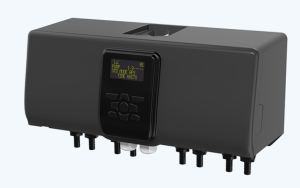
IoT Dosing System